

Human-in-Control AI Agents: Automating Work Without Losing Oversight
Jan. 31, 2026
974

Table of Contents
Artificial Intelligence (AI) is rapidly reshaping the way organizations work. Businesses are investing in AI systems that can automate repetitive tasks, speed up processes, and even make decisions previously handled by humans. Among the most talked‑about developments in this shift are AI agents, automated systems designed to execute tasks, analyze data, and act on instructions with minimal human intervention.
However, as adoption accelerates, leaders are realizing a critical truth: full automation without oversight can lead to unpredictability, errors, and risk. A growing number of experts argue that AI works best when humans remain in control, guiding, reviewing, and supervising the actions of AI agents. This human‑centric approach combines the strengths of machines and people to achieve efficiency without sacrificing reliability or accountability.
In this article, we explore what Human‑in‑Control AI Agents and Human‑in‑the‑Loop (HITL) systems are, why businesses prefer them, how they work, where they’re used, and best practices for implementation.
Key Takeaways
-
AI agents can automate repetitive work and boost efficiency, but without human oversight, they often fail to deliver consistent value.
-
Human‑in‑Control and Human‑in‑the‑Loop approaches ensure risk is managed, trust is built, and quality is preserved.
-
Research shows that AI performs best when humans guide key decisions, correct errors, and provide context.
-
Organizations should balance automation with oversight, define clear roles, and support teams with training.
-
As AI becomes more powerful, human judgment will remain essential for ethical, reliable, and strategic outcomes.
Why Human Oversight in AI Is Essential?
Recent enterprise experience shows that AI agents introduced without proper human oversight often fail to deliver on their promise. As highlighted in a Forbes analysis, many organizations launch autonomous agents expecting rapid gains, only to find that the technology stumbles when faced with ambiguity or real‑world complexity. So,
-
AI agents frequently stall because companies lack accountability, governance, and human decision points.
-
Surveys show that a significant portion of consumers and executives believe AI needs human oversight, especially in sensitive or high‑stakes contexts.
This aligns with broader industry data showing that enterprises are adopting AI agents faster than they are putting oversight systems in place. For example, a recent Deloitte report found that AI agent usage could rise from about 23% to 74% in the next two years, yet only around 21% of companies have robust safety and oversight mechanisms configured.
You can Also Read about Why U.S. Companies Should Prioritize AI Software Development for Competitive Advantage
What Human‑in‑Control and Human‑in‑the‑Loop Mean?
Human‑in‑Control AI Agents
These are AI systems designed to automate work, but humans remain responsible for critical decisions. The idea is not to remove humans from the equation, but to amplify human capacity with automation, letting machines handle routine work while humans validate outcomes.
In this model:
-
AI suggests or performs an action.
-
A human reviews, approves, edits, or overrides it.
-
The AI uses that feedback to improve future recommendations.
This structure keeps responsibility and accountability with humans while benefiting from automation.
Human‑in‑the‑Loop (HITL) AI
HITL refers to AI workflows where humans continuously interact with the system. Research across industries shows that human involvement improves accuracy, accountability, and contextual judgement when AI outputs involve high‑impact decisions.
In both cases, human involvement is not a burden, it’s a necessary safeguard, especially in contexts where nuance, ethics, or business impact are significant
How Human‑in‑Control AI Agents Work in Practice?
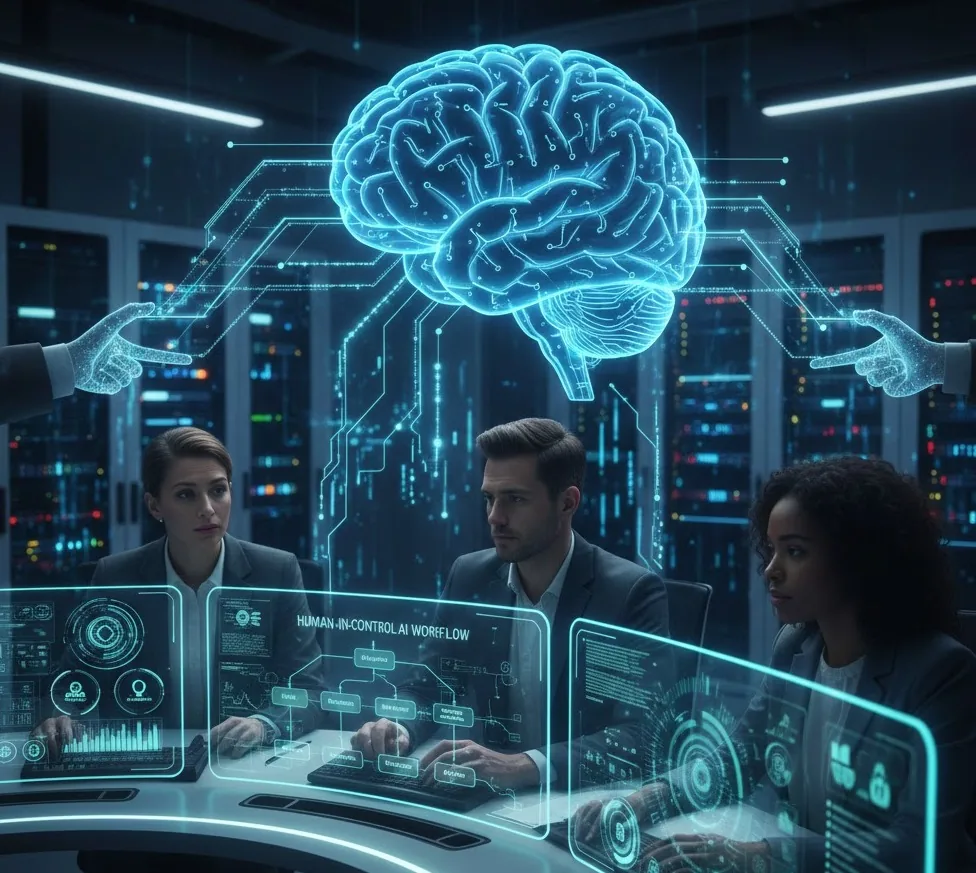
A typical Human‑in‑Control workflow looks like this:
- A repetitive or rule‑based task is chosen for automation.
- The AI agent generates a suggested action, response, or decision
- A human user reviews the suggestion, approving it, modifying it, or rejecting it
- Once approved, the action is executed (e.g., sending a response, updating a record, or prioritizing a case)
- The human’s decision is fed back into the AI model to improve future behavior.
This approach lets AI accelerate repetitive work while humans focus on decisions that require judgment, strategic thinking, or ethical consideration.
Where Human‑in‑Control AI Agents Excel?
1. Customer Service and Support
AI agents can draft responses to common queries, prioritize tickets, or suggest categorization. A support agent human then reviews the draft before it’s sent.
This maintains speed without sacrificing quality or brand consistency.
2. Sales and Lead Qualification
AI can score leads based on behavior and generate follow‑up suggestions, but humans decide which leads move forward and how to personalize outreach. According to the Forbes article, this blended model is already being used to accelerate workflows while protecting customer relationships and trust.
3. Finance and Compliance
In financial forecasting or fraud detection, AI can flag anomalies or patterns. Financial professionals then assess the flagged items, the human validation is critical where compliance, legal obligations, or financial risk are concerned. This is backed by industry reviews showing that while AI can process vast datasets effectively, human judgment is required to interpret ambiguous variables.
4. Healthcare and Diagnostics
In settings like medical imaging or diagnostics, AI algorithms can detect subtle trends in data, but clinicians review, interpret, and finalize diagnoses. Practice in pharmaceutical verification and medical imaging demonstrates that human–AI collaboration improves accuracy while keeping clinicians in control.
Benefits of Human‑in‑Control AI Systems
1. Reduced Risk and Error
AI alone can misinterpret edge cases or act unpredictably. Having humans review outputs prevents mistakes from impacting outcomes.
2. Greater Trust and Adoption
Teams are more comfortable using AI when they retain oversight and control. Surveys show significant consumer and executive skepticism about fully autonomous AI, reinforcing the need for human checkpoints.
3. Improved Learning Over Time
Human feedback helps AI agents become better. Instead of acting purely by algorithmic inference, agents learn from corrected decisions, making future suggestions more accurate.
4. Ethical and Legal Accountability
AI systems may make decisions at scale such as in legal, medical, or financial contexts, humans must be responsible. Governance frameworks are essential to meet ethical and compliance standards.
Challenges
Even with the best design, implementing Human‑in‑Control AI Agents requires careful planning:
Too much human review can slow processes, while too little increases risk. A clear definition of when human involvement is needed based on task severity or potential impact. Teams must establish which actions are safe for autonomous AI, which require validation, and where escalation to senior reviewers is necessary.
AI agents rely on clean, structured data. Poor input leads to poor output. Organizations must invest in data governance and integration before deploying advanced agents.
AI adoption fails when teams lack understanding or trust in the technology. Training programs that explain how agents work and emphasize human oversight build confidence.
Read about Digitalization in Hospitality Industry: Key Benefits and Challenges
What Research and Industry Experts Say
Recent analyses reinforce the critical role of human oversight in AI agent deployment. According to Forbes, many organizations struggle when they introduce agents without clear operational clarity about who controls them and how they should interact with workflows. Experts note that effective AI deployment depends on integrating humans as the final layer of judgment.
Broader research supports this view: human‑in‑loop systems in specialized settings, such as mental health support or clinical diagnostics not only enhance accuracy but also improve outcomes in ways that pure automation cannot.
These steps help organizations scale AI automation responsibly and sustainably.